'We'll have fun together': Trump talks up presidency, but still trails behind Obama in latest poll results
By Daily Mail Reporter
Last updated at 8:31 PM on 19th April 2011
Trump polls 34% Vs. Obama on 49%
Tycoon calls for seizing Iraqi oilfields to compensate U.S.
'The Donald' hits out at Karl Rove: 'He gave us Obama'
Trump proving popular with GOP members
'I'll release tax returns when Obama releases birth certificate'
Donald Trump would loose to Barack Obama by a massive 15 percentage points in a presidential election, a poll suggests.
But while the president would theoretically win against Trump, who polled 34 per cent, he is still unable to break the 50 per cent barrier, and is instead stuck on 49 per cent - even against a candidate many still consider a rank outsider.
The Rasmussen poll results come as The Apprentice star hit out at former Bush Jr. advisor Karl Rove before telling the Boston Herald: 'I really believe that we would all have lots of fun together'.
Scroll down for video
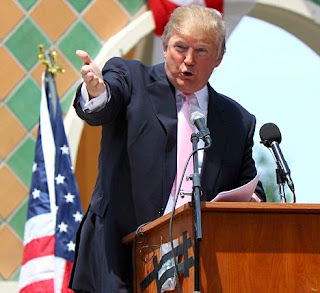
Outspoken: Donald Trump has called on the U.S. to seize Iraqi oil fields in compensation
In an interview with America's Morning News, Mr Trump hit back at Mr Rove calling him a 'joke', saying: 'Honestly, Karl Rove ought to go back and start thinking about other things because what he did is, he gave us, indirectly through President Bush, he gave us Barack Obama.'
And in another interview, the outspoken businessman declared the U.S. should seize Libyan and Iraqi oil fields to reimburse the country for the '$1.5 trillion' spent removing Saddam Hussein.
Speaking on ABC last night, he said: 'Look at what’s going on with your gasoline prices.
President of Your Bathroom
In a more bizarre twist, the will-he-wont-he candidate has found the time to patent a new line of bath products called 'Success by Trump'.
A patent application, filed on April 7 read: 'SUCCESS BY TRUMP for use in selling 'cologne; perfume; fragrances; after-shave lotions; skin moisturiser; shampoo; conditioner; deodorant; soaps for hand, face, and body; body powder; bath oil; bath gel; bath salts; [and] bubble bath.'
They’re going to go to $5, $6, $7 and we don’t have anybody in Washington that calls OPEC and says, 'Fellas, it’s time. It’s over. You’re not going to do it any more.
'I don’t know if you saw yesterday, Saudi Arabia came out and said very strongly there’s plenty of oil.
'They wouldn’t even be there if it wasn’t for us. If it weren’t for us, they wouldn’t be there. These 12 guys sit around a table and they say, 'Let’s just screw the United States.'
Trump went on to suggest the U.S. should threaten to remove key military assets from countries such as Saudi Arabia in order to force them to produce more oil, thus lowering the domestic gasoline price.
On the subject of Iraq, the billionaire was even more outspoken, declaring the U.S. should station troops to seize oil fields as compensation for the money America has spent 'liberating' the country.
He said: 'We go into Iraq. We have spent thus far, $1.5 trillion. We could have rebuilt half of the United States. $1.5 trillion.
'And we’re going to then leave. So, in the old days, you know when you had a war, to the victor belong the spoils. You go in. You win the war and you take it.
Action: Along with seizing oil fields, Trump has also called for a removal of U.S. military assets from countries such as Saudi Arabia to help reduce the oil price
The latest Rasmussen survey of 1000 potential voters found that the president earned support from 49 per cent nationwide, while Trump attracted a respectable 34 per cent.
Given that choice, 12 per cent would vote for some other candidate, and five percent are undecided.
The results come as GOP activists in Iowa, New Hampshire and South Carolina appear deeply intrigued by, and open to, a run by Donald Trump - despite the fact he perpetuates falsehoods about Obama's citizenship and questions the legitimacy of his presidency.
Glenn McCall, Republican Party chairman in South Carolina's York County, said: 'I hear more and more people talking about Donald Trump.
'He is saying on the national stage what other people won't talk about.
'That includes holding forth on trade, China and oil dependency.
Shadow: trump's success has come at the expense of more established candidates such as Sarah Palin
'But Trump's biggest buzz stems from his embrace of the claim that Obama wasn't born in the United States, and therefore is constitutionally barred from being president.
'He's got people fired up.'
Trump's rising star comes at the expense of the more established Republican candidates Sarah Palin and former governors Mitt Romney of Massachusetts and Tim Pawlenty of Minnesota.
A CNN nationwide poll of adult Republicans showed Trump tied for the presidential lead with former Arkansas Governor Mike Huckabee, at 19 percent each.
Palin, the 2008 vice presidential nominee, was third at 12 percent.
Continuing the 'birther' debate, Trump also declared to ABC he would, 'release his tax returns when Obama releases his birth certificate.'
The businessman has previously refused to release the details of his finances.
Explore more:People: Saddam Hussein, Sarah Palin, Barack Obama, Mike Huckabee, Donald Trump Places: Washington, China, Iraq, America Organisations: Republican Party Print this article Read later Email to a friend Share this article: Twitter Digg it Newsvine Delicious MySpace Nowpublic Reddit Fark Ads by Google:
 Read more: http://www.dailymail.co.uk/news/article-1378513/Seize-Iraqi-oil-fields-Donald-Trump-talks-tough-trails-Barack-Obama-latest-poll-results.html#ixzz1K2KuQnX2
By Daily Mail Reporter
Last updated at 8:31 PM on 19th April 2011
Trump polls 34% Vs. Obama on 49%
Tycoon calls for seizing Iraqi oilfields to compensate U.S.
'The Donald' hits out at Karl Rove: 'He gave us Obama'
Trump proving popular with GOP members
'I'll release tax returns when Obama releases birth certificate'
Donald Trump would loose to Barack Obama by a massive 15 percentage points in a presidential election, a poll suggests.
But while the president would theoretically win against Trump, who polled 34 per cent, he is still unable to break the 50 per cent barrier, and is instead stuck on 49 per cent - even against a candidate many still consider a rank outsider.
The Rasmussen poll results come as The Apprentice star hit out at former Bush Jr. advisor Karl Rove before telling the Boston Herald: 'I really believe that we would all have lots of fun together'.
Scroll down for video
Outspoken: Donald Trump has called on the U.S. to seize Iraqi oil fields in compensation
In an interview with America's Morning News, Mr Trump hit back at Mr Rove calling him a 'joke', saying: 'Honestly, Karl Rove ought to go back and start thinking about other things because what he did is, he gave us, indirectly through President Bush, he gave us Barack Obama.'
And in another interview, the outspoken businessman declared the U.S. should seize Libyan and Iraqi oil fields to reimburse the country for the '$1.5 trillion' spent removing Saddam Hussein.
Speaking on ABC last night, he said: 'Look at what’s going on with your gasoline prices.
President of Your Bathroom
In a more bizarre twist, the will-he-wont-he candidate has found the time to patent a new line of bath products called 'Success by Trump'.
A patent application, filed on April 7 read: 'SUCCESS BY TRUMP for use in selling 'cologne; perfume; fragrances; after-shave lotions; skin moisturiser; shampoo; conditioner; deodorant; soaps for hand, face, and body; body powder; bath oil; bath gel; bath salts; [and] bubble bath.'
They’re going to go to $5, $6, $7 and we don’t have anybody in Washington that calls OPEC and says, 'Fellas, it’s time. It’s over. You’re not going to do it any more.
'I don’t know if you saw yesterday, Saudi Arabia came out and said very strongly there’s plenty of oil.
'They wouldn’t even be there if it wasn’t for us. If it weren’t for us, they wouldn’t be there. These 12 guys sit around a table and they say, 'Let’s just screw the United States.'
Trump went on to suggest the U.S. should threaten to remove key military assets from countries such as Saudi Arabia in order to force them to produce more oil, thus lowering the domestic gasoline price.
On the subject of Iraq, the billionaire was even more outspoken, declaring the U.S. should station troops to seize oil fields as compensation for the money America has spent 'liberating' the country.
He said: 'We go into Iraq. We have spent thus far, $1.5 trillion. We could have rebuilt half of the United States. $1.5 trillion.
'And we’re going to then leave. So, in the old days, you know when you had a war, to the victor belong the spoils. You go in. You win the war and you take it.
Action: Along with seizing oil fields, Trump has also called for a removal of U.S. military assets from countries such as Saudi Arabia to help reduce the oil price
The latest Rasmussen survey of 1000 potential voters found that the president earned support from 49 per cent nationwide, while Trump attracted a respectable 34 per cent.
Given that choice, 12 per cent would vote for some other candidate, and five percent are undecided.
The results come as GOP activists in Iowa, New Hampshire and South Carolina appear deeply intrigued by, and open to, a run by Donald Trump - despite the fact he perpetuates falsehoods about Obama's citizenship and questions the legitimacy of his presidency.
Glenn McCall, Republican Party chairman in South Carolina's York County, said: 'I hear more and more people talking about Donald Trump.
'He is saying on the national stage what other people won't talk about.
'That includes holding forth on trade, China and oil dependency.
Shadow: trump's success has come at the expense of more established candidates such as Sarah Palin
'But Trump's biggest buzz stems from his embrace of the claim that Obama wasn't born in the United States, and therefore is constitutionally barred from being president.
'He's got people fired up.'
Trump's rising star comes at the expense of the more established Republican candidates Sarah Palin and former governors Mitt Romney of Massachusetts and Tim Pawlenty of Minnesota.
A CNN nationwide poll of adult Republicans showed Trump tied for the presidential lead with former Arkansas Governor Mike Huckabee, at 19 percent each.
Palin, the 2008 vice presidential nominee, was third at 12 percent.
Continuing the 'birther' debate, Trump also declared to ABC he would, 'release his tax returns when Obama releases his birth certificate.'
The businessman has previously refused to release the details of his finances.
Explore more:People: Saddam Hussein, Sarah Palin, Barack Obama, Mike Huckabee, Donald Trump Places: Washington, China, Iraq, America Organisations: Republican Party Print this article Read later Email to a friend Share this article: Twitter Digg it Newsvine Delicious MySpace Nowpublic Reddit Fark Ads by Google:


